

X
  • About
  • Advertise
  • Contact
  • Events
Subscribe to our Newsletter
  • News
    • Markets
    • Regulation
    • Super
    • M&A
    • Tech
    • Appointments
  • Podcast
  • Webcasts
  • Video
  • Analysis
  • Promoted Content
No Results
View All Results
  • News
    • Markets
    • Regulation
    • Super
    • M&A
    • Tech
    • Appointments
  • Podcast
  • Webcasts
  • Video
  • Analysis
  • Promoted Content
No Results
View All Results
No Results
View All Results
Home News Markets

Chief economist captures 2024 in one chart

As Australia counts down to a rate cut, an economist has emphasised the critical need for a boost in productivity.

by Jessica Penny
December 23, 2024
in Markets, News
Reading Time: 3 mins read
Share on FacebookShare on Twitter

While it’s difficult for one data set to represent a year of economic volatility, HSBC’s Paul Bloxham says that a key story for the Australian economy has been its weak productivity performance.

HSBC has noted throughout the year that productivity could be a reason the Reserve Bank opts not to cut rates in 2024, despite most other developed market central banks doing so.

“Although demand has slowed, weak productivity has constrained the supply-side of the economy, contributing to sticky inflation,” Bloxham said.

The economist said that key questions for 2025 will be why productivity has been so weak, what it means, and importantly, how to fix it.
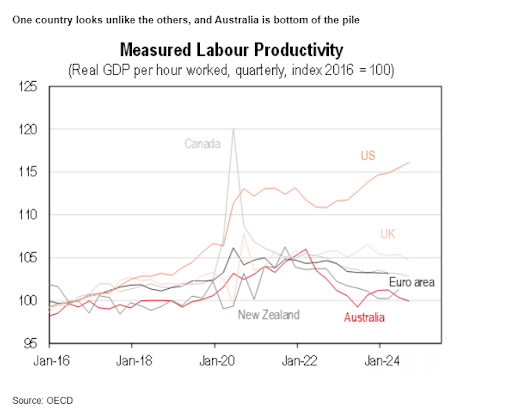
Not only has measured labour productivity fallen, Bloxham underscored, a longer-term perspective indicates that it is no higher now than it was in 2016.

“As is well understood, lifting productivity is the main way that most countries lift national incomes and living standards. As it turns out, there is another way to do this – that is, to sell what you produce for an ever-increasing price – and this other way is what Australia has done for much of the first two decades of this century.”

X

During this period, he explained, Australia has benefited from a substantial rise in its terms of trade, coupled with a boost to iron ore, glass, and coal production on the back of the mining investment boom around the turn of the century.

But the economist pointed out that mining investment is now much lower than it was back then, with prices for these products having slumped from their peaks.

“A focus on productivity is needed if Australia is to continue to lift its living standards meaningfully,” Bloxham said, noting that key opportunities are likely within renewables, the green transition and education exports with a keen focus on trading with Asia.

While many other countries are encountering similar productivity challenges, the US has been an outlier. The bank suspects that the US’ stronger productivity growth has played a key role in its soft landing.

“In short, demand has not needed to weaken much to get inflation to fall because the supply-side of the economy has improved substantially, partly because productivity growth has been strong.

“We have argued that part of the explanation for the divergence in the recent cyclical productivity performance across these countries could reflect the design of the pandemic policy response,” Bloxham said.

Namely, most Western countries “deep freeze” policy measures though the pandemic offered greater protection for economies, but likely limited business dynamism.

On the other side of the coin, the US had a hard recession through the pandemic but is also seeing the typical cyclical pick-up in productivity that comes after a hard recession, following significant jobs market and business sector churn.

Expounding on this, Bloxham said that Australia is operating on the other side of this spectrum.

“Productivity has been weak and with growth in demand slowing, but not declining – as has been seen in other countries like New Zealand, the UK and some European economies – Australian inflation has been sticky and elevated.

“Australia needs productivity to pick-up not just to improve living standards but also to help disinflate and allow the RBA to cut rates.”

Looking ahead, he believes that a “broad-based” policy approach is needed.

“This should include a focus on tax reform, competition policy, deregulation and improving the availability of skill workers.

“As Australia heads towards a federal election in 2025 (by 17 May at the latest), how to lift productivity ought to be a key focus,” Bloxham said.


Related Posts

Janus Henderson to go private following US$7.4bn acquisition

by Laura Dew
December 23, 2025

Global asset manager Janus Henderson has been acquired by Trian Fund Management and General Catalyst in a US$7.4 billion deal....

Australian Super targets $1trn within a decade

by Adrian Suljanovic
December 22, 2025

Australia’s largest superannuation fund has announced it is targeting $1 trillion in assets by 2035, up from its current size...

The biggest people moves of Q4

by Olivia Grace-Curran
December 22, 2025

InvestorDaily collates the biggest hires and exits in the financial service space from the final three months of 2025. Movements...

Leave a Reply Cancel reply

Your email address will not be published. Required fields are marked *

VIEW ALL
Promoted Content

Why U.S. middle market private credit is a powerful income solution for Australian institutional investors

In today’s investment landscape, middle market direct lending, a key segment of private credit, has emerged as an attractive option...

by Tim Warrick
December 2, 2025
Promoted Content

Is Your SMSF Missing Out on the Crypto Boom?

Digital assets are the fastest-growing investment in SMSFs. Swyftx's expert team helps you securely and compliantly add crypto to your...

by Swyftx
December 2, 2025
Promoted Content

Global dividends reach US$519 billion, what’s behind the rise?

Global dividends surged to a record US$518.7 billion in Q3 2025, up 6.2% year-on-year, with financials leading the way. The...

by Capital Group
November 18, 2025
Promoted Content

Why smaller can be smarter in private credit

Over the past 15 years, middle market direct lending has grown into one of the most dynamic areas of alternative...

by Tim Warrick, Managing Director of Principal Alternative Credit, Principal Asset Management
November 14, 2025

Join our newsletter

View our privacy policy, collection notice and terms and conditions to understand how we use your personal information.

Latest Podcast

Podcast

Relative Return Insider: MYEFO, US data and a 2025 wrap up

by Staff Writer
December 18, 2025
After more than two decades, InvestorDaily continues to be an institution that connects and influences Australia’s financial services sector. This influential and integrated media brand connects with leading financial services professionals within superannuation, funds management, financial planning and intermediary distribution through a range of channels, including digital, social, research, broadcast, webcast and events.

Subscribe to our newsletter

View our privacy policy, collection notice and terms and conditions to understand how we use your personal information.

About Us

  • About
  • Advertise
  • Contact
  • Terms & Conditions
  • Privacy Collection Notice
  • Privacy Policy

Popular Topics

  • Markets
  • Appointments
  • Regulation
  • Super
  • Mergers & Acquisitions
  • Tech
  • Promoted Content
  • Analysis

© 2025 All Rights Reserved. All content published on this site is the property of Prime Creative Media. Unauthorised reproduction is prohibited

No Results
View All Results
NEWSLETTER
  • News
  • Markets
  • Regulation
  • Super
  • M&A
  • Tech
  • Appointments
  • Podcast
  • Webcasts
  • Promoted Content
  • Events
  • About
  • Advertise
  • Contact Us

© 2025 All Rights Reserved. All content published on this site is the property of Prime Creative Media. Unauthorised reproduction is prohibited